The humble five-cent piece might not seem like a treasure hunter's prize, but some nickels are worth far more than face value — we're talking hundreds, thousands, even millions of dollars. From early Shield nickels to modern Jefferson varieties, here's your complete guide to rare nickels worth money and how to spot them in your pocket change.
Why Are Some Nickels So Valuable?
Nickels have been minted in the United States since 1866, and across that 160-year span, certain dates, mint marks, and varieties have become incredibly scarce. Low mintage numbers, historical significance, minting errors, and collector demand all drive value. Unlike cents or dimes, nickel compositions have stayed relatively stable (75% copper, 25% nickel for most of their history), which means collectors focus heavily on rarity and condition rather than metal content.
The nickel series also includes some of the most iconic designs in American numismatics — the Buffalo (Indian Head) nickel and the classic Jefferson profile — making these coins popular with both serious collectors and casual enthusiasts.
The Most Valuable Nickels of All Time
Before we dive into what you might find in circulation, let's look at the holy grails — the nickels that have commanded jaw-dropping prices at auction:
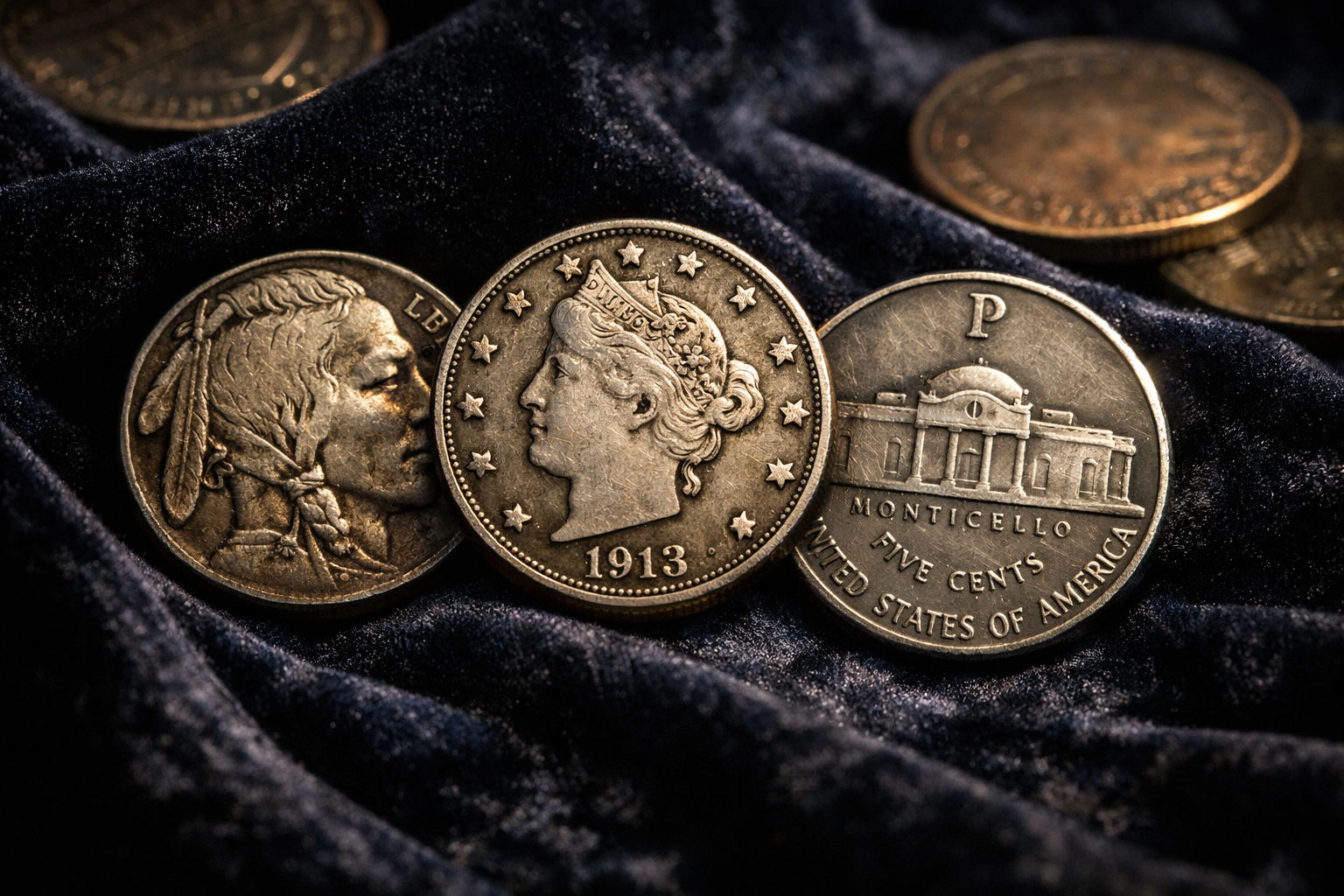
- 1913 Liberty Head Nickel: Only five known to exist. The most recent sale topped $4.5 million. These were never officially produced — someone at the Mint struck them secretly before the Buffalo design took over.
- 1918/7-D Buffalo Nickel: An overdate error where a 1918 die was punched over a 1917 die. In high grades, this coin sells for $100,000 or more.
- 1926-S Buffalo Nickel: With a mintage of just 970,000, this is the lowest-mintage regular-issue Buffalo nickel. Uncirculated examples command $30,000 to $75,000.
- 1937-D 3-Legged Buffalo Nickel: A famous error where over-polishing of the die removed one of the buffalo's legs. Worth $500 to $50,000 depending on grade.
- 1942-D Over Horizontal D Jefferson Nickel: A dramatic repunched mintmark. High-grade examples have sold for over $10,000.
Buffalo Nickels: Key Dates and Values
The Buffalo nickel (1913–1938) is one of the most beautiful coins ever produced by the U.S. Mint, designed by James Earle Fraser. The obverse features a composite portrait of three Native American chiefs, while the reverse shows an American bison. These coins circulated heavily, and many have worn-down dates, which actually makes well-preserved examples even more valuable.
Here are the key dates every collector should know:
- 1913-S Type 2: $75 to $5,000+ — the first year of issue with the recessed mound design
- 1913-D Type 2: $60 to $3,000+ — Denver mint, same year
- 1914/3 Overdate: $200 to $15,000 — look closely at the "4" for traces of a "3" beneath it
- 1915-S: $30 to $3,500 — low mintage San Francisco issue
- 1921-S: $40 to $8,000 — one of the scarcest regular dates
- 1924-S: $15 to $7,000 — tough to find in any condition above Good
- 1926-S: $30 to $75,000 — the key date of the series
- 1937-D 3-Legged: $500 to $50,000 — the most famous Buffalo nickel error
Even common-date Buffalo nickels in good condition are worth $1 to $5, and any with a full, readable date command at least $2 to $3. If you find one in your change with sharp horn detail on the buffalo, that's a sign of a higher grade and potentially more value.
Jefferson Nickels Worth Money
Jefferson nickels have been minted since 1938, and while most are worth face value, several dates and varieties stand out. The series is especially popular because you can still find valuable specimens in pocket change — unlike Buffalo nickels, which rarely show up anymore.
War Nickels (1942–1945)
During World War II, nickel was needed for the war effort, so the Mint changed the five-cent coin's composition to 56% copper, 35% silver, and 9% manganese. These "war nickels" are easy to identify — they have a large mintmark (P, D, or S) above Monticello on the reverse.
Every war nickel contains about 0.0563 troy ounces of silver. At current silver prices, that alone makes them worth $1.50 to $2.00 each in any condition. Key dates in the series include:
- 1942-P (silver): $3 to $100 — the first Philadelphia nickel with a mintmark
- 1943-P 3 Over 2 Overdate: $50 to $5,000 — traces of a "2" visible under the "3"
- 1943/2-P Doubled Eye: $30 to $300 — doubling visible on Jefferson's eye
- 1945-P Double Die Reverse: $20 to $500 — look for doubling on "MONTICELLO"
Key Date Jefferson Nickels
Beyond the war years, these Jefferson nickels are the ones to watch for:
- 1938-D: $5 to $100 — first year of issue, Denver mint
- 1938-S: $5 to $80 — first year, San Francisco mint
- 1939-D: $8 to $200 — low mintage of just 3.5 million
- 1939-S: $3 to $50 — another scarce early date
- 1950-D: $10 to $50 — only 2.6 million struck, the lowest-mintage Jefferson nickel
- 1954-S: $1 to $30 — the last San Francisco nickel until the 1960s
Full Steps Jefferson Nickels: The Condition Premium
One of the most important value factors for Jefferson nickels is the "Full Steps" (FS) designation. On the reverse, Monticello has a set of steps leading up to the building. On most circulated — and even many uncirculated — nickels, these steps are mushy or partially struck. When all five or six steps are fully defined, the coin receives a "Full Steps" designation from grading services, and its value can skyrocket.
For example, a 1950-D Jefferson nickel in MS-65 might sell for $20, but with a Full Steps designation, that same coin can be worth $200 to $500. Some dates are nearly impossible to find with Full Steps, making those examples extraordinarily valuable. The 1953-S in MS-66 Full Steps has sold for over $15,000.
Modern Jefferson Nickel Errors Worth Looking For
You don't need to find a century-old coin to score a valuable nickel. Modern Jefferson nickels from the 2000s and beyond have their own errors and varieties that collectors pay premiums for:
- 2004-D Wisconsin Extra Leaf (Peace Medal reverse): Some coins show an extra detail resembling a leaf. Worth $50 to $200.
- 2005-D Speared Bison: A die scratch creates what looks like a spear going through the bison on the Westward Journey reverse. Worth $20 to $100.
- 2009-D Double Die Reverse: Noticeable doubling on Monticello. Worth $10 to $50.
- Off-center strikes: Any modern nickel struck significantly off-center with a readable date can sell for $20 to $100+.
- Wrong planchet errors: A Jefferson nickel struck on a cent planchet or dime planchet is worth $200 or more.
Identify Your Nickels Instantly
Found a nickel that looks unusual? Don't guess — snap a photo and let the Coin Identifier app analyze it with AI. Whether it's a Buffalo nickel with a worn date or a Jefferson variety you can't quite place, our app can help you identify what you've got and estimate its value in seconds.
Download Coin Identifier free and find out what your nickels are really worth!
Shield and Liberty Head Nickels
Before the Buffalo nickel came two earlier five-cent designs that are also highly collectible:
Shield Nickels (1866–1883): The first true five-cent nickel coin. Key dates include the 1880 (only 16,000 minted, worth $400 to $5,000) and the 1879 (25,900 minted, similar values). Even common dates in Good condition are worth $20 to $40.
Liberty Head (V) Nickels (1883–1912): The first year (1883) came in two types — with and without the word "CENTS" on the reverse. The "No CENTS" variety was gold-plated by fraudsters and passed off as $5 gold pieces, prompting the Mint to quickly add "CENTS." The 1885 Liberty Head nickel is the key date, with only 1.5 million struck, worth $250 to $10,000+. And of course, the legendary 1913 Liberty Head nickel — never officially issued, with only five known — is worth millions.
How to Check Your Nickels for Value
Here's a quick checklist for evaluating any nickel you come across:
- Check the date first. If it's 1938 or earlier, it's automatically worth investigating. Any Buffalo nickel with a full date is worth at least $1–3.
- Look for large mintmarks above Monticello. A big "P," "D," or "S" over the dome means it's a silver war nickel worth at minimum its silver melt value.
- Examine the condition. Sharp details, original luster, and no damage dramatically increase value. For Jefferson nickels, check Monticello's steps.
- Inspect for errors. Use a magnifying glass to check for doubled letters, off-center strikes, die cracks, or unusual features.
- Weigh it. A standard nickel weighs 5.0 grams. If yours is noticeably off, it could be a wrong-planchet error.
- Use an app. Coin identification apps with AI can quickly help you compare your coin against known varieties and key dates.
Where to Find Rare Nickels
While the odds of finding a 1913 Liberty Head in your couch cushions are essentially zero, valuable nickels do turn up in surprising places:
- Coin roll hunting: Buy rolls of nickels from your bank and search through them. War nickels and occasional Buffalo nickels still show up.
- Inherited collections: Old jars, albums, and collections passed down through families are prime hunting grounds.
- Estate sales and flea markets: Many sellers don't know what they have. A quick check of dates can reveal hidden gems.
- Metal detecting: Parks, old homesteads, and former fairgrounds have yielded Buffalo and even Liberty Head nickels.
- Change checking: It's less common now, but war nickels and early Jefferson dates do occasionally appear in circulation.
Storing and Protecting Your Valuable Nickels
Once you find a nickel worth keeping, proper storage is essential. Never clean a coin — cleaning almost always destroys value. Instead:
- Store coins in acid-free 2x2 cardboard flips or non-PVC soft flips
- Keep them in a cool, dry place away from direct sunlight
- Handle coins by the edges only — oils from your fingers can cause spots and discoloration over time
- For valuable specimens ($100+), consider professional grading and encapsulation by PCGS or NGC
Every Nickel Tells a Story
From Civil War-era Shield nickels to modern Full Steps specimens, the five-cent piece has one of the richest histories in American coinage. Whether you're searching through bank rolls or examining a family heirloom, the Coin Identifier app makes it easy to figure out exactly what you've got. Snap a photo, get instant identification, and discover if your nickel is worth a fortune. Download free today and start your treasure hunt!