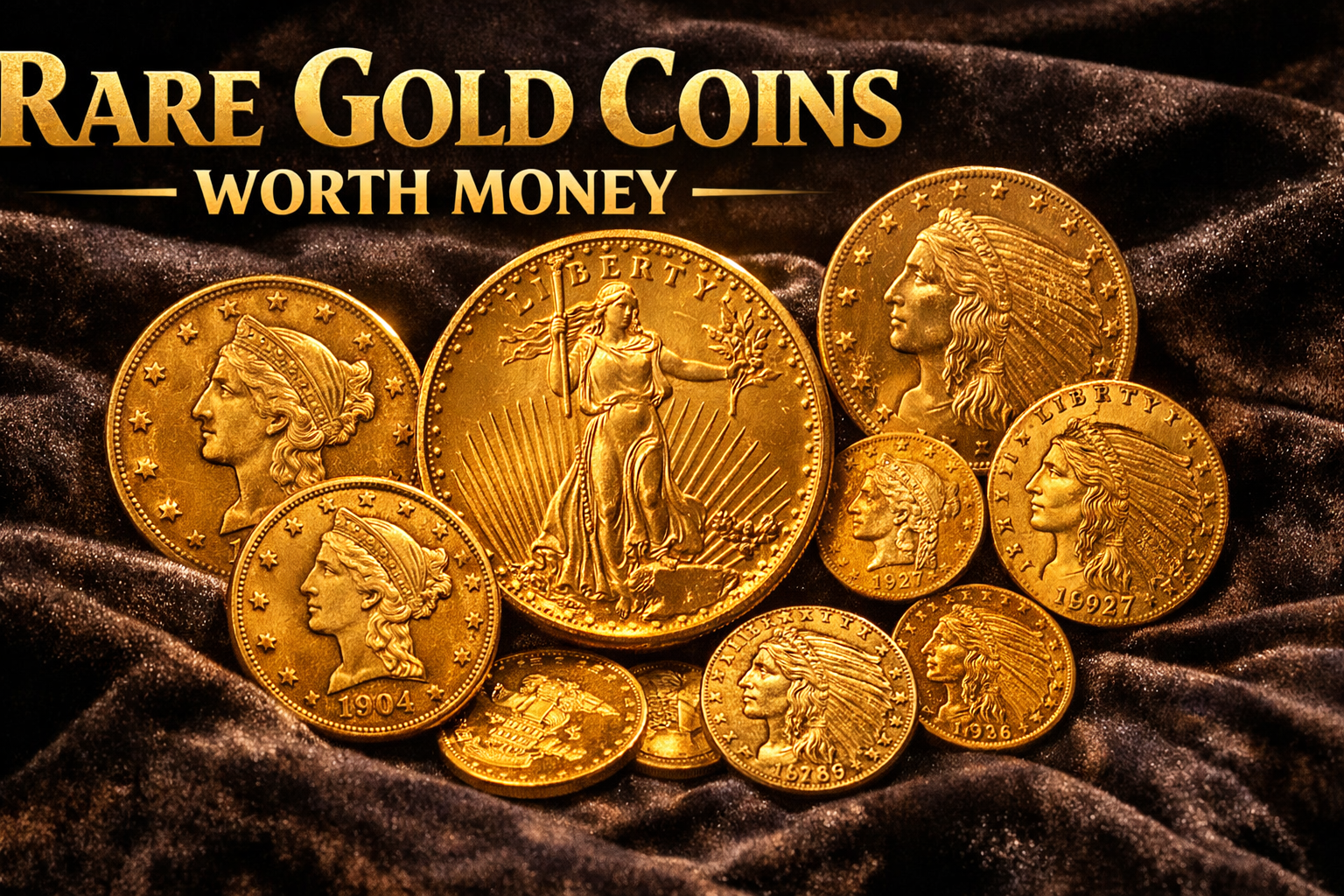
Gold coins have captivated collectors and investors for centuries, and the most rare gold coins worth money can sell for millions at auction. From pre-Civil War gold dollars to legendary Double Eagles, the U.S. Mint produced some of the most sought-after gold coins in numismatic history. Here's your complete guide to which gold coins are valuable, what drives their prices, and how to spot the key dates hiding in collections and estate sales.
Why Gold Coins Command Such High Prices
Unlike silver or copper coins, gold coins carry intrinsic metal value that creates a high price floor. A single U.S. gold eagle ($10 face value) contains 0.4838 troy ounces of gold — worth over $1,100 at today's gold prices regardless of its numismatic value. But collectors pay far beyond melt value for coins with low mintages, historical significance, or exceptional condition.
The U.S. Mint produced gold coins from 1795 to 1933, when President Roosevelt's Executive Order 6102 halted gold coin production and recalled gold from circulation. That 138-year window produced some of the rarest, most beautiful, and most valuable coins in the world.
The Most Valuable U.S. Gold Coins Ever Sold
These are the gold coins that have shattered auction records and made headlines worldwide:
- 1933 Saint-Gaudens Double Eagle: Sold for $18.9 million in 2021 at Sotheby's, making it the most expensive coin ever sold. Nearly all 445,500 minted were melted after the gold recall — only one is legally owned by a private collector.
- 1822 Half Eagle ($5): Only three are known to exist. Two reside in the Smithsonian, and the sole privately held example last sold for $8.4 million in 2021.
- 1849 Double Eagle Pattern: The first $20 gold coin ever struck, it exists as a unique pattern piece held by the Smithsonian. It's considered priceless.
- 1907 Ultra High Relief Double Eagle: A limited striking of Augustus Saint-Gaudens' original design with extraordinary depth. Examples sell for $1 million to $3 million.
- 1854-S Half Eagle: Only three known from the San Francisco Mint's early days. Worth $2 million to $4 million.
U.S. Gold Coin Denominations Explained
The U.S. Mint produced gold coins in six denominations, each with its own collector following:
- Gold Dollar ($1): Produced 1849–1889. The smallest U.S. gold coin at just 13mm diameter. Three design types: Liberty Head, Small Indian Head, and Large Indian Head.
- Quarter Eagle ($2.50): Produced 1796–1929. The Indian Head design (1908–1929) features a unique incuse (sunken) design — the only U.S. coin struck this way.
- Three-Dollar Gold Piece: Produced 1854–1889. An oddball denomination that never caught on with the public, making survivors scarce.
- Half Eagle ($5): Produced 1795–1929. America's first gold coin denomination and one of the longest-running series.
- Eagle ($10): Produced 1795–1933. The workhorse of U.S. gold coinage, used extensively in commerce.
- Double Eagle ($20): Produced 1849–1933. The largest regular-issue U.S. gold coin, containing nearly a full ounce of gold (0.9675 oz).
Saint-Gaudens Double Eagles: The King of Gold Coins
The Saint-Gaudens Double Eagle (1907–1933) is widely considered the most beautiful coin ever produced by the U.S. Mint. Designed by sculptor Augustus Saint-Gaudens at President Theodore Roosevelt's personal request, the coin features a striding Liberty on the obverse and a flying eagle on the reverse.
Key dates and varieties to know:
- 1907 High Relief: The original design required three strikes per coin, making mass production impossible. About 12,367 were struck before the design was flattened. Worth $10,000 to $50,000 depending on grade.
- 1907 Ultra High Relief: An even more extreme version with just 20 or fewer struck as patterns. Worth $1 million to $3 million.
- 1908-S: Just 22,000 minted — the lowest regular mintage Saint-Gaudens. Worth $8,000 to $100,000+.
- 1920-S: Only 558,000 struck, with most melted. Survivors in mint state sell for $20,000 to $200,000.
- 1921: Just 528,500 minted, the rarest date available in quantity. Worth $15,000 to $100,000 in mint state.
- 1926-S to 1927-S: San Francisco issues from these years are scarce, with the 1927-D being a major rarity at $300,000+.
- 1933: The ultimate rarity. Worth $10 million to $18.9 million, but legal ownership is extremely restricted.
Common-date Saint-Gaudens Double Eagles (1924, 1927, 1928) trade for about 5–10% over gold melt value, making them an excellent entry point into gold coin collecting. You get a stunning coin with nearly an ounce of gold for a modest premium.
Liberty Head Gold Coins Worth Serious Money
Before Saint-Gaudens, the Liberty Head design dominated U.S. gold coinage. Liberty Head gold coins span multiple denominations and nearly a century of production (1838–1908 for most types), with numerous key dates that collectors chase.
Liberty Head Double Eagles ($20, 1849–1907)
- 1854-O: Just 3,250 minted in New Orleans. Worth $15,000 to $200,000.
- 1856-O: Only 2,250 struck. Worth $20,000 to $250,000.
- 1861 Paquet Reverse: A briefly used reverse design. Worth $100,000 to $2 million.
- 1870-CC: The first Carson City gold coin, with just 3,789 struck. Worth $50,000 to $500,000.
- Carson City dates (1870–1893): All CC-mint Double Eagles carry premiums from $2,000 to $500,000+ depending on date and condition.
Liberty Head Eagles ($10, 1838–1907)
- 1858: Only 2,521 minted at Philadelphia. Worth $5,000 to $50,000.
- 1875: Just 100 business strikes produced — one of the rarest regular-issue U.S. coins. Worth $100,000+.
- 1883-O: Only 800 minted. Worth $10,000 to $75,000.
- Carson City Eagles: Similar to Double Eagles, all CC-mint eagles carry collector premiums.
Indian Head Gold Coins: Unique and Underappreciated
The Indian Head gold series features two distinct and unconventional designs that stand out in American numismatics.
Indian Head Quarter Eagle ($2.50, 1908–1929)
Designed by Bela Lyon Pratt, this coin features an incuse (recessed) design — the image is stamped into the coin rather than raised above the surface. This was controversial when released, with some critics claiming the recesses would harbor germs. Today, collectors prize the unique aesthetic.
- 1911-D: The undisputed key date with just 55,680 minted. Worth $2,000 to $25,000.
- 1914: Low mintage of 240,000. Worth $200 to $5,000 in mint state.
- 1914-D: Only 448,000 struck. Worth $200 to $4,000.
Indian Head Eagle ($10, 1907–1933)
Saint-Gaudens also designed this coin, featuring Liberty wearing a Native American headdress. It's one of the most distinctive designs in U.S. coinage.
- 1907 Wire Rim: An early striking variety with a thin wire rim. Worth $5,000 to $30,000.
- 1911-D: Only 30,100 minted. Worth $500 to $25,000.
- 1920-S: Just 126,500 struck, with most melted. Worth $10,000 to $100,000+.
- 1930-S: Only 96,000 minted — a late date rarity. Worth $5,000 to $50,000.
- 1933: The last year of production. Only 312,500 minted, but nearly all were melted. Survivors bring $30,000 to $300,000.
Identify Your Gold Coins Instantly
Found a gold coin in a collection or estate sale? Don't guess at its value — snap a photo and let the Coin Identifier app analyze it with AI. Whether it's a Saint-Gaudens Double Eagle, a Liberty Head half eagle, or an Indian Head quarter eagle, our app identifies your coin's type, date, mint mark, and estimated value in seconds.
Download Coin Identifier free and discover what your gold coins are really worth!
Gold Dollars: Small but Mighty
Gold dollars (1849–1889) are the smallest U.S. gold coins ever produced — just 13mm across, about the size of a modern dime. Despite their tiny size, some are worth serious money:
- 1849-C Open Wreath: The first Charlotte Mint gold dollar. Worth $500 to $10,000.
- 1855-C: Only 9,803 minted. Worth $1,000 to $15,000.
- 1855-D: Just 1,811 struck at Dahlonega. Worth $3,000 to $25,000.
- 1861-D: The last Dahlonega gold dollar, struck just before the Confederacy seized the mint. Only 1,250 produced. Worth $5,000 to $30,000.
- 1875: Just 400 business strikes — one of the rarest gold dollars by mintage. Worth $5,000 to $20,000.
Southern branch mint gold dollars (Charlotte "C" and Dahlonega "D") are especially collectible because both mints had short lifespans — Charlotte operated from 1838 to 1861, and Dahlonega from 1838 to 1861. Every coin from these mints carries a premium simply for its origin.
Three-Dollar Gold Pieces: The Forgotten Denomination
The three-dollar gold piece (1854–1889) is one of the most unusual denominations in U.S. coinage. It was created to simplify purchasing sheets of three-cent stamps, but the public never embraced it. Mintages were consistently low, making virtually every date collectible.
- 1854-D: Just 1,120 minted at Dahlonega. Worth $10,000 to $75,000.
- 1855-S: Only 6,600 struck in San Francisco. Worth $3,000 to $20,000.
- 1870-S: Unique — only one confirmed example. Worth over $1 million if it ever sells.
- 1875: Just 20 business strikes. Worth $20,000 to $100,000.
- 1876: Only 45 minted. Worth $15,000 to $80,000.
How to Spot a Fake Gold Coin
Counterfeiting is a serious issue in gold coin collecting. The high value of gold coins makes them a prime target for forgers. Here's how to protect yourself:
- Weight: Gold has a specific gravity of 19.32 — extremely dense. A genuine $20 Double Eagle weighs exactly 33.436 grams. Even slight deviations are a red flag. Use a precision scale accurate to 0.01 grams.
- Diameter: Measure with calipers. Double Eagles should be 34.1mm. Most fakes are slightly off.
- Sound: Gold coins produce a distinct, high-pitched ring when tapped. Base metals sound dull and flat.
- Magnet test: Gold is not magnetic. If a coin sticks to a strong neodymium magnet, it's fake. Note: some counterfeit metals are also non-magnetic, so this test alone isn't conclusive.
- Edge lettering and reeding: Compare the edge details to known genuine examples. Many counterfeits have mushy or incorrect edge details.
- Buy certified: For expensive coins, always buy PCGS or NGC graded coins in tamper-evident holders. The grading services guarantee authenticity.
Gold Coins as an Investment
Gold coins sit at the intersection of numismatic collecting and precious metals investing. Common-date gold coins in circulated condition trade close to their melt value, giving you gold exposure with minimal collector premium. Key dates and high-grade coins, meanwhile, have historically outperformed gold bullion over long periods.
Some practical guidelines for gold coin investors:
- Best value for gold content: Common-date Saint-Gaudens and Liberty Head Double Eagles trade at 5–15% over melt. You get historical gold coins for barely more than bullion.
- Best appreciation potential: Key date coins in mid-grades (VF to AU) have shown strong long-term appreciation as collector demand grows while supply is fixed.
- Avoid cleaned coins: Cleaning destroys a coin's original surface and can reduce its value by 50% or more. Always buy coins with original, uncleaned surfaces.
- Storage matters: Store gold coins in inert holders (Mylar flips or NGC/PCGS slabs). Never use PVC-containing holders, which can damage coins over time.
Where to Find Rare Gold Coins
Unlike silver dimes or copper pennies, gold coins rarely appear in pocket change — they haven't circulated since 1933. Here's where to look:
- Estate sales and inheritances: Many families hold gold coins passed down through generations without realizing their numismatic value. If you're settling an estate, have every gold coin individually evaluated.
- Major auction houses: Heritage Auctions, Stack's Bowers, and Great Collections handle the finest gold coins. Auction records are public and excellent for price research.
- Reputable dealers: Buy from dealers who are members of the Professional Numismatists Guild (PNG) or the American Numismatic Association (ANA). They adhere to codes of ethics and offer return policies.
- Coin shows: Large shows like the ANA World's Fair of Money, FUN Show, and Long Beach Expo attract hundreds of dealers with significant gold coin inventories.
- Shipwreck recoveries: Coins from famous shipwrecks like the SS Central America (1857) and SS Republic (1865) are available with dramatic provenance stories.
Start Identifying Your Gold Coins Today
Whether you've inherited a small gold coin you can't identify or spotted a Double Eagle at a flea market, the Coin Identifier app makes it easy to figure out exactly what you have. Snap a photo, and our AI will identify the denomination, date, mint mark, and estimated value in seconds. No numismatic expertise required — just point your camera and discover if you're holding a fortune. Download free today!