Half dollars are the heavyweight champions of U.S. pocket change — larger, heavier, and often more valuable than collectors realize. From early Bust halves struck by hand to Walking Liberty masterpieces and Kennedy-era errors, rare half dollars worth money are scattered across collections, estate boxes, and bank rolls everywhere. Here's your complete guide to which fifty-cent pieces are worth a fortune and how to find them.
Why Half Dollars Are a Collector's Sweet Spot
The half dollar occupies a unique place in American numismatics. It's been struck continuously since 1794, making it one of the longest-running denominations in U.S. coinage. Unlike dimes and quarters, half dollars were often saved rather than spent — their size made them feel "too valuable" for everyday transactions. That means more survivors in higher grades, but it also means the truly rare dates stand out even more dramatically.
Every half dollar minted from 1794 through 1970 contains silver — 90% silver through 1964, and 40% silver from 1965 to 1970. Even common-date silver halves have a melt value around $10 at current silver prices, giving them a strong floor. But the rare ones? They can be worth hundreds, thousands, or even millions.
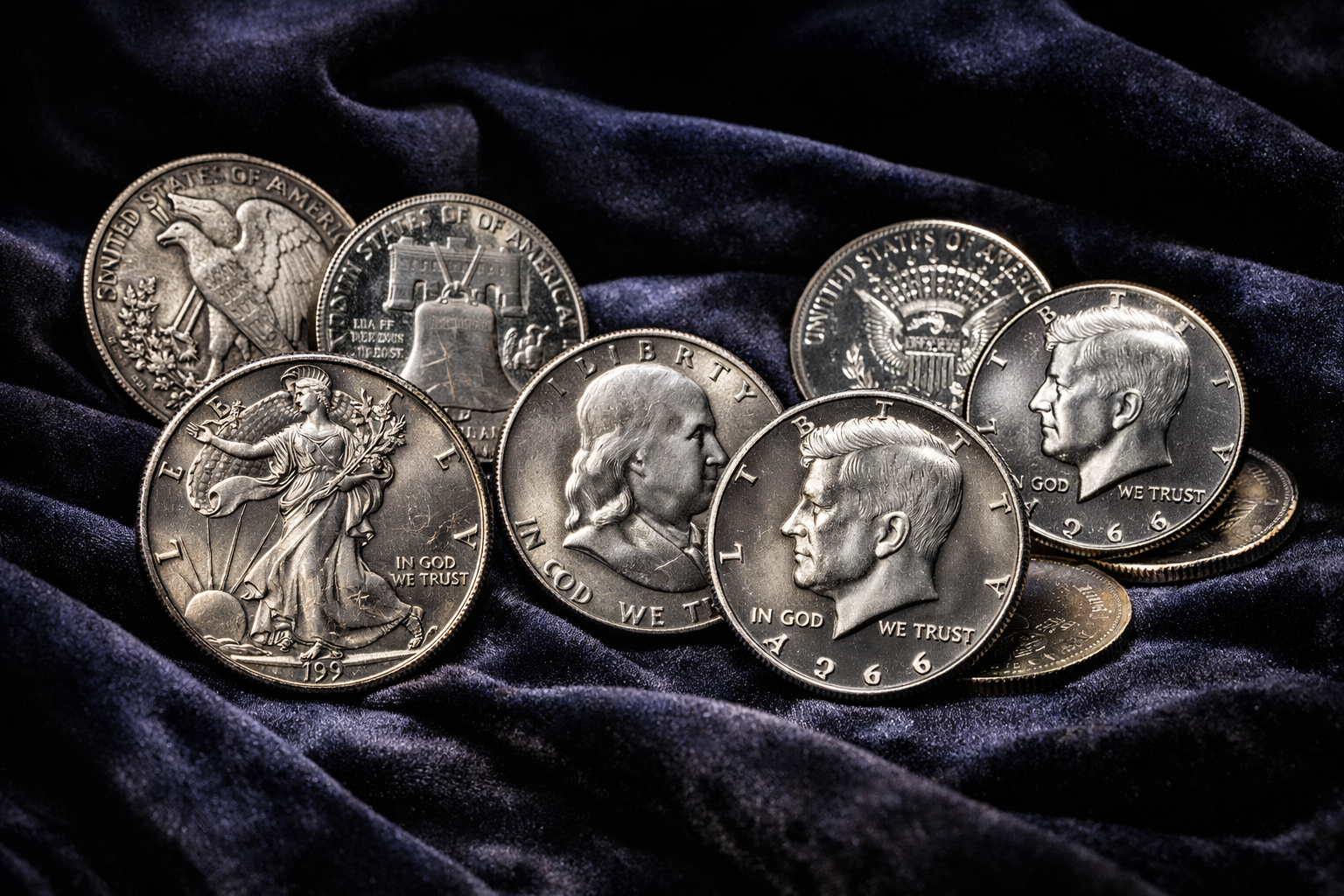
The Most Valuable Half Dollars Ever Sold
Before we get into what you might realistically find, here are the half dollars that have shattered auction records:
- 1797 Draped Bust Half Dollar: Only 3,918 struck in the first small-eagle reverse year. High-grade examples have sold for over $1.5 million. One of the rarest early American coins in any denomination.
- 1838-O Capped Bust Half Dollar: The first half dollar struck at the New Orleans Mint, with only 20 proof restrikes known. One sold for $763,750 in 2014.
- 1796 Draped Bust (15 Stars): With a mintage of just 3,918 combined with the 1797, this is the holy grail for Bust half collectors. Values range from $30,000 in low grades to $500,000+.
- 1853-O No Arrows Seated Liberty: Only 4 known examples exist. The New Orleans Mint struck these before receiving the new arrow-design dies. Last sale: $763,750.
- 1921 Walking Liberty Half Dollar: A key date with just 246,000 struck. Worth $100 in Good condition, up to $20,000+ in mint state.
Walking Liberty Half Dollars (1916–1947): America's Most Beautiful Coin
Adolph Weinman's Walking Liberty design is widely considered the most beautiful coin in U.S. history — so iconic that the U.S. Mint revived it for the American Silver Eagle bullion coin in 1986. The series runs from 1916 to 1947, with all dates containing 90% silver (0.3617 troy ounces). Walking Liberty halves are heavily collected by date and mint mark, and the key dates are genuinely scarce.
Here are the Walking Liberty half dollar key dates you need to know:
- 1916-S: $60 to $5,000 — the first-year San Francisco issue with a mintage of 508,000. Obverse mint mark variety.
- 1917-S (Obverse): $20 to $5,000 — the mint mark appears on the obverse (front) for this year only. Easily confused with the reverse variety.
- 1919-D: $20 to $8,000 — only 1.17 million minted. Very scarce in grades above Fine.
- 1919-S: $20 to $10,000 — just 1.55 million from San Francisco. One of the toughest dates to find in mint state.
- 1921: $60 to $20,000 — the lowest-mintage Walker at just 246,000. A true key date that anchors any serious collection.
- 1921-D: $80 to $15,000 — only 208,000 struck, making it the second-rarest date. Difficult in any grade.
- 1921-S: $15 to $15,000 — 548,000 minted, but very few survived in high grades.
- 1938-D: $50 to $2,000 — the semi-key of the later dates with just 491,600 minted.
What Makes Walking Liberties Valuable?
Beyond key dates, Walking Liberty halves have a unique grading challenge. The high points of Liberty's hand and head wear quickly, making truly high-grade examples scarce for almost every date. Coins grading MS-65 or above command significant premiums even for common dates. A common-date Walker in MS-67 can sell for $1,000+ simply because so few exist that nice.
Franklin Half Dollars (1948–1963): The Underrated Series
The Franklin half dollar is one of the most underappreciated series in U.S. numismatics. Running from 1948 to 1963, these 90% silver coins feature Benjamin Franklin on the obverse and the Liberty Bell on the reverse. While there are no extreme rarities, several dates are surprisingly valuable in high grades.
The key to Franklin half dollar values is the "Full Bell Lines" (FBL) designation. On the reverse, the lower portion of the Liberty Bell has horizontal lines. When these lines are complete and unbroken, grading services assign the coveted FBL designation — and values can jump dramatically.
- 1949-S: $20 to $600 — the lowest-mintage Franklin at 3.74 million. Worth much more with Full Bell Lines.
- 1953: $8 to $2,500 — a common date that becomes a condition rarity in MS-66 FBL. Extremely tough to find fully struck.
- 1955: $6 to $500 — "Bugs Bunny" die clash variety shows what looks like buck teeth on Franklin. A fun and collectible error.
- 1961: $6 to $3,000 — incredibly scarce in MS-66 FBL. Registry set collectors drive these prices.
- 1962: $6 to $1,200 — another date that's common in low grades but extremely rare with Full Bell Lines in gem condition.
Franklin halves are arguably the best value in silver half dollar collecting right now. You can assemble a complete date-and-mint set in circulated grades for under $400, and the FBL hunting adds a challenging dimension that keeps the series engaging for advanced collectors.
Kennedy Half Dollars (1964–Present): Modern Treasures
Introduced in 1964 just months after President Kennedy's assassination, the Kennedy half dollar was an instant collectible. The 1964 issue is 90% silver with a mintage over 400 million — most were hoarded by a grieving public and never circulated. From 1965 to 1970, Kennedy halves contain 40% silver. After 1970, they're copper-nickel clad (except special collector editions).
While most Kennedy halves aren't rare, several dates and varieties command serious premiums:
- 1964 Accented Hair: $15 to $3,000+ — an early die variety with extra detail in Kennedy's hair above the ear. Proof versions in PR-69 sell for $5,000+. The variety was quickly replaced, making the Accented Hair the scarcer version.
- 1964 SMS (Special Mint Set): Extremely rare — possibly 10-20 known. These coins have a satin finish different from both business strikes and proofs. A single example sold for $108,000.
- 1966 SMS Doubled Die Obverse: $100 to $1,000 — clear doubling visible on "IN GOD WE TRUST" and the date. A popular and visually dramatic variety.
- 1970-D: $25 to $300 — the last 40% silver Kennedy, with a relatively low mintage of 2.15 million. Only sold in Mint Sets, never released for circulation.
- 1998-S Matte Finish: $100 to $300 — a special matte proof included only in the 1998 Robert F. Kennedy commemorative set. Mintage of just 62,000.
- 2014-W Gold Kennedy: $1,200 to $2,000 — a 3/4 oz gold proof struck for the 50th anniversary. Not pocket change, but an important Kennedy issue.
Kennedy Half Dollar Error Coins
Kennedy halves have produced some spectacular errors over the decades. Because the coins are large, errors tend to be dramatic and visually striking — which makes them popular with collectors:
- Wrong planchet errors: Kennedy halves struck on quarter or dime planchets. These are worth $500 to $5,000 depending on the denomination and condition.
- Off-center strikes: Coins struck 10-50% off-center with a full date visible. Values range from $50 for minor off-centers to $500+ for dramatic examples.
- Doubled die varieties: Several dates show doubling on the obverse lettering or date. The most dramatic ones bring $100 to $1,000+.
- Clad layer missing: Kennedy halves where one or both clad layers failed to bond, revealing the copper core. Worth $100 to $400.
Barber Half Dollars (1892–1915): The Overlooked Classic
Charles Barber's Liberty Head design was used on half dollars from 1892 to 1915. These coins are 90% silver and were heavily circulated — finding one in high grade is a genuine challenge. The series has several legitimate rarities that even experienced collectors overlook.
- 1892-O Micro O: $200 to $10,000 — a tiny mint mark variety from New Orleans. Dramatically rarer than the normal "O" version.
- 1893-S: $100 to $25,000 — just 740,000 minted, one of the key dates in the series.
- 1897-O: $60 to $15,000 — only 632,000 struck. Very scarce above Fine.
- 1897-S: $100 to $10,000 — another low-mintage San Francisco issue at 933,900.
- 1904-S: $50 to $7,000 — the semi-key with just 553,038 minted.
- 1913: $50 to $5,000 — a late-date rarity with only 188,627 struck at Philadelphia. The lowest-mintage regular-issue Barber half from any mint.
- 1914: $70 to $6,000 — just 124,610 minted, another very scarce late date.
- 1915: $50 to $5,000 — the final year with 138,000 from Philadelphia. A natural set-completion coin that commands a premium.
Where to Find Rare Half Dollars
Half dollars are actually easier to find than you might think — they're just not in everyday pocket change anymore. Here are the best hunting grounds:
- Bank rolls: Many banks still have half dollar rolls available. Ask for customer-wrapped rolls for the best chance of finding silver or older dates. Some coin roll hunters go through thousands of dollars in halves and regularly find silver.
- Estate sales and inherited collections: Half dollars were frequently saved in jars, drawers, and boxes. Estate lots often contain pre-1965 silver halves mixed in with modern clad.
- Coin shows: Dealers at regional coin shows often have boxes of unsorted or semi-sorted halves at reasonable prices. Great for cherry-picking varieties and errors.
- Online auctions: eBay and Heritage Auctions are excellent for both buying and researching values. Always compare sold listings, not asking prices.
How to Identify Valuable Half Dollars
Not sure what you're looking at? Here's a quick checklist for evaluating any half dollar:
- Check the date: Pre-1965 means 90% silver. 1965-1970 means 40% silver. Post-1970 is clad (usually face value unless it's an error).
- Look at the edge: A solid silver edge vs. a copper-nickel sandwich tells you instantly whether a coin is silver.
- Examine the mint mark: D (Denver), S (San Francisco), O (New Orleans — pre-1910), CC (Carson City). No mint mark means Philadelphia.
- Check for errors: Look for doubling on lettering, off-center strikes, missing clad layers, or die cracks. Use a magnifying glass or your phone's camera zoom.
- Assess the condition: Even common dates in exceptional condition (MS-65 or above) can be worth significant premiums.
Building a Half Dollar Collection
Half dollars offer some of the best entry points into serious coin collecting. Here are three approaches at different budget levels:
Kennedy Date Set (Budget: $50–$300): Collect one half dollar from each year 1964 to present. It's an affordable way to start, with the 1964 and 1970-D as the highlight coins. You can upgrade individual dates over time.
Franklin Complete Set (Budget: $400–$2,000): Just 35 coins covering 1948 to 1963. No impossible rarities, all 90% silver, and the Full Bell Lines challenge adds depth. One of the best value propositions in half dollar collecting.
Walking Liberty Date Set (Budget: $1,000–$10,000+): The crown jewel of half dollar collecting. Completing a date set without the 1921-S and 1921-D is achievable for around $1,000 in Good condition. Adding the key dates pushes the budget higher but rewards you with one of the most beautiful sets in all of numismatics.
Type Set (Budget: $200–$5,000): Collect one example of each major half dollar design — Flowing Hair, Draped Bust, Capped Bust, Seated Liberty, Barber, Walking Liberty, Franklin, and Kennedy. Eight coins spanning the entire history of the denomination.
Start Identifying Your Half Dollars Today
From early Draped Bust rarities to modern Kennedy errors, half dollars are packed with hidden value waiting to be discovered. Whether you're sorting through a coin jar, hunting bank rolls, or evaluating an inherited collection, the Coin Identifier app makes it easy to identify what you've got in seconds. Snap a photo, get AI-powered identification, and find out if your half dollar is worth a fortune. Download free today!