Dimes are the smallest U.S. coins in circulation, but some are worth a small fortune. From early Draped Bust rarities to Mercury dime key dates and modern Roosevelt errors, rare dimes worth money are hiding in collections, coin rolls, and even your pocket change. Here's your complete guide to which dimes are valuable and how to spot them.
Why Are Some Dimes Worth So Much?
The U.S. dime has been struck since 1796, giving it one of the longest production histories in American coinage. Several factors drive dime values sky-high: low mintage numbers, historical significance, die errors, and silver content. Every dime minted before 1965 contains 90% silver (0.0723 troy ounces), which gives even common dates a base melt value of around $2.00 at current silver prices.
But the truly rare dimes — the ones that sell for thousands or millions — combine scarcity with collector demand. Low-mintage dates, dramatic errors, and coins in exceptional condition command premiums that can shock even experienced numismatists.
The Most Valuable Dimes Ever Sold
Before diving into what you might realistically find, here are the dimes that have made auction headlines:
- 1894-S Barber Dime: Only 24 struck, with roughly 9 known to survive. One sold for $1.99 million in 2016. The story goes that the San Francisco Mint superintendent struck them as presentation pieces for banker friends.
- 1796 Draped Bust Dime: The first year of U.S. dime production, with just 22,135 minted. High-grade examples sell for $50,000 to $500,000+.
- 1873-CC No Arrows Seated Liberty Dime: Only one known example exists from the Carson City Mint. It last sold for $1.84 million.
- 1916-D Mercury Dime: The undisputed key date of the Mercury series with just 264,000 struck. Worth $1,000 in Good condition, up to $50,000+ in mint state.
- 1798/7 Draped Bust Overdate: A dramatic overdate variety worth $1,500 to $30,000 depending on grade.
Mercury Dimes: The Collector's Favorite
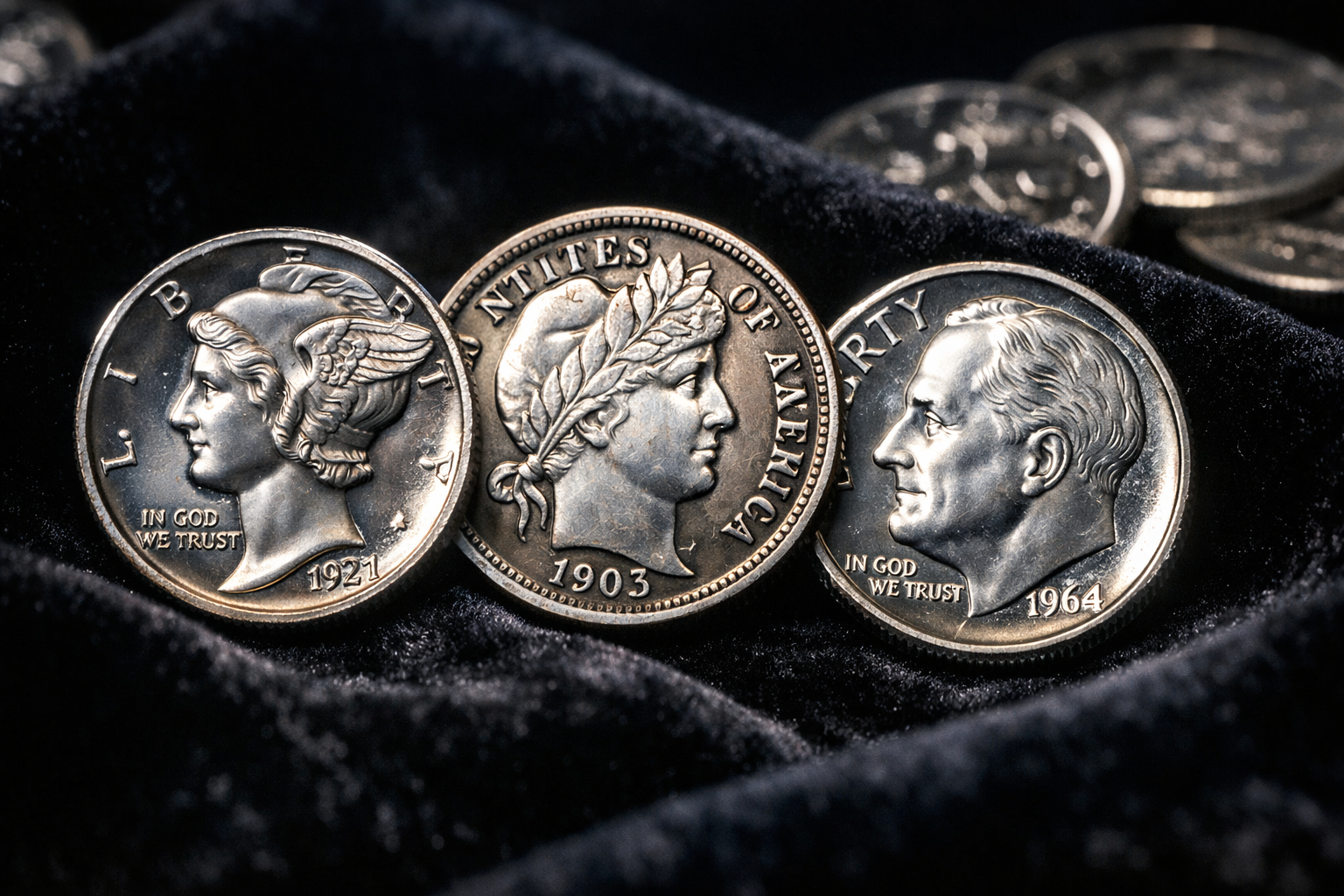
The Mercury dime (1916–1945), officially known as the Winged Liberty Head dime, is one of the most beautiful American coin designs. Adolph Weinman's depiction of Liberty wearing a winged cap (symbolizing freedom of thought) has captivated collectors for over a century. These 90% silver dimes are actively collected by date and mint mark, and several key dates command serious premiums.
Here are the Mercury dime key dates every collector needs to know:
- 1916-D: $1,000 to $50,000+ — THE key date, only 264,000 minted in Denver. Beware fakes — altered mint marks are common.
- 1921: $50 to $3,000 — only 1.08 million struck at Philadelphia after a five-year hiatus.
- 1921-D: $60 to $5,000 — just 1.08 million from Denver, the second-rarest regular date.
- 1926-S: $8 to $8,000 — a semi-key with low mintage of 1.52 million.
- 1931-D: $8 to $1,000 — Depression-era mintage of just 1.26 million.
- 1942/1: $400 to $15,000 — a dramatic overdate where "42" was punched over "41." Exists in both Philadelphia and Denver versions.
- 1942/1-D: $500 to $20,000 — the Denver version of the overdate, even scarcer.
Full Bands Mercury Dimes
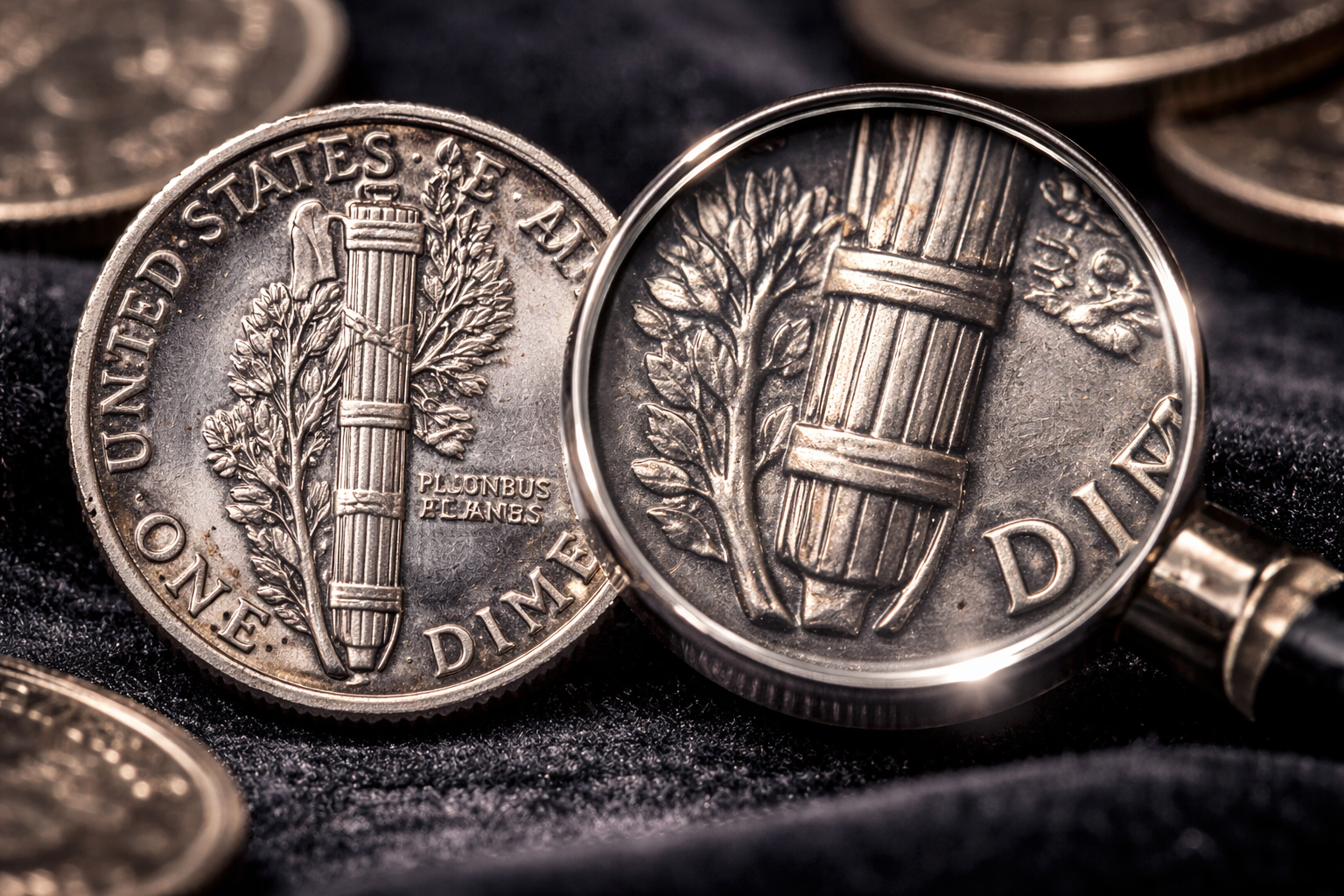
Similar to "Full Steps" on Jefferson nickels, Mercury dimes have their own condition premium called "Full Bands" (FB). On the reverse, the fasces (a bundle of rods) is bound by horizontal bands. When these bands are fully separated and sharply struck, the coin receives a Full Bands designation from grading services — and its value can multiply dramatically.
For example, a common-date 1944 Mercury dime in MS-66 might sell for $30, but with Full Bands, that same coin can bring $75 to $150. For scarcer dates, the FB premium is even more dramatic. A 1945-S in MS-67 FB recently sold for over $4,000.
Roosevelt Dimes Worth Money
Roosevelt dimes have been produced since 1946, and while most post-1964 examples are worth face value, the silver years (1946–1964) and certain errors make this series more interesting than many collectors realize.
Silver Roosevelt Key Dates (1946–1964)
All Roosevelt dimes from 1946 to 1964 are 90% silver, worth at least $2.00 in melt value. But certain dates trade well above silver content:
- 1949-S: $3 to $200 — the lowest-mintage silver Roosevelt at just 13.5 million.
- 1950-S: $3 to $100 — another scarce San Francisco issue.
- 1952-S: $3 to $80 — low mintage, hard to find in high grades.
- 1955: $3 to $100 — only 12.8 million struck at Philadelphia.
- 1955-D: $3 to $60 — the Denver counterpart, also low mintage.
- 1955-S: $3 to $80 — San Francisco rounds out a universally scarce year.
Valuable Roosevelt Dime Errors
Modern Roosevelt dimes from the clad era (1965–present) are generally worth ten cents. But errors change everything:
- 1965 Silver Roosevelt Dime: When the Mint switched to clad in 1965, a few dimes were accidentally struck on leftover silver planchets. These "transition errors" sell for $5,000 to $15,000. Test with a magnet — silver won't stick, clad will slide slowly.
- 1968 No-S Proof Dime: Proof coins from San Francisco should have an "S" mintmark. A small number of 1968 proofs were struck without it. Worth $15,000 to $25,000.
- 1970 No-S Proof Dime: Same error, two years later. Only about 2,200 are believed to exist. Worth $500 to $3,000.
- 1975 No-S Proof Dime: The rarest of all No-S proof dimes, with only two confirmed examples. One sold for $450,000 in 2019.
- 1982 No-P Dime: In 1980, Philadelphia began adding a "P" mintmark to dimes. In 1982, some were struck without it. Worth $50 to $300.
- Off-center strikes: Any dime struck noticeably off-center with a readable date can sell for $20 to $200+.
- Wrong planchet errors: A dime struck on a cent or nickel planchet is worth $200 to $1,000+.
Identify Your Dimes Instantly
Found a dime that looks unusual? Don't guess — snap a photo and let the Coin Identifier app analyze it with AI. Whether it's a Mercury dime with a suspicious mint mark or a Roosevelt error you can't quite place, our app identifies your coin and estimates its value in seconds.
Download Coin Identifier free and discover what your dimes are really worth!
Barber Dimes: Overlooked and Undervalued
Barber dimes (1892–1916), designed by Charles E. Barber, are often overshadowed by the glamorous Mercury series. But they offer excellent value for collectors, with many key dates surprisingly affordable compared to their actual scarcity.
Key Barber dimes to look for:
- 1894-S: $200,000 to $2,000,000 — the holy grail, only 24 minted.
- 1895-O: $40 to $4,000 — just 440,000 struck in New Orleans.
- 1901-S: $100 to $15,000 — only 593,022 minted, the key date for accessible collectors.
- 1903-S: $40 to $3,000 — another scarce San Francisco issue.
- 1904-S: $20 to $2,000 — low mintage, often found in heavily worn condition.
Common-date Barber dimes in Good condition are worth $3 to $8, making them an affordable entry point into pre-1916 silver coinage. They're also underrepresented in most collections, meaning demand could grow as more collectors discover the series.
Seated Liberty and Early Dimes
For collectors with deeper pockets, the Seated Liberty (1837–1891), Capped Bust (1809–1837), and Draped Bust (1796–1807) dimes offer incredible historical depth. These coins were struck when America was still a young nation, and survivors carry genuine historical weight.
Standout early dimes include:
- 1796: $1,500 to $500,000 — the first U.S. dime, with the small eagle reverse.
- 1797 16 Stars: $1,500 to $100,000 — features 16 stars for the 16 states at the time.
- 1809: $50 to $5,000 — first year of the Capped Bust design.
- 1860-O Seated Liberty: $10 to $2,000 — last New Orleans dime before the Civil War shut down the mint.
- 1873-CC No Arrows: $500,000 to $2,000,000 — unique survivor from Carson City.
- 1874-CC: $100 to $10,000 — only 10,817 minted at Carson City with the arrows design.
How to Check If Your Dime Is Valuable
Here's a quick step-by-step process for evaluating any dime:
- Check the date. Anything 1964 or earlier is silver and worth at least $2.00. Pre-1916 dimes are always worth investigating further.
- Look at the edge. A solid silver-colored edge means 90% silver. A copper-sandwich edge means clad (post-1964). If you find a post-1964 date with a silver edge, you may have a transition error worth thousands.
- Examine the mint mark. On Mercury dimes, it's on the reverse near the bottom. On Roosevelt dimes, it moved from the reverse (pre-1968) to the obverse (1968+). Missing mint marks on proof coins are especially valuable.
- Check for errors. Use a magnifying glass to look for doubled die lettering, off-center strikes, and repunched mint marks.
- Assess the condition. For Mercury dimes, check the Full Bands on the reverse fasces. For Roosevelt dimes, look for sharp torch lines on the reverse.
- Weigh it. A silver dime weighs 2.50 grams; a clad dime weighs 2.27 grams. An off-weight coin could be a planchet error.
Where to Find Rare Dimes
Rare dimes turn up more often than you might think. Here are the best places to search:
- Coin roll hunting: Buy boxes of dimes from your bank ($250 per box, 50 rolls of $5 each). Silver dimes, especially Mercury dimes, still appear in bank rolls — roughly 1 in every 500-1,000 coins.
- Old collections and estates: Inherited coin collections are goldmines. Many people saved silver dimes without knowing which dates were rare.
- Coin shows: Dealers bring large inventories, and you can inspect coins in person. Great for finding undergraded bargains.
- Metal detecting: Mercury and Barber dimes are common metal detecting finds at old sites, parks, and homesteads.
- Online auctions: eBay and Heritage Auctions are good hunting grounds, but learn to spot fakes before buying raw coins online.
Building a Dime Collection: Where to Start
If you want to collect dimes seriously, here are three popular approaches:
Complete Roosevelt Set (1946–present): The most accessible dime series. Common dates in circulated condition cost $2 to $5 each (silver years) or face value (clad years). The whole set minus proof-only issues can be assembled for under $500. It's a great starter project.
Mercury Dime Date Set: More challenging and more rewarding. You can build a complete date set (excluding the 1916-D) for roughly $500 to $2,000 in Good to Fine condition. Add the 1916-D later when your budget allows.
Type Set: Collect one example of each major dime design — Draped Bust, Capped Bust, Seated Liberty, Barber, Mercury, and Roosevelt. Six coins spanning 230 years of American history. Budget roughly $300 to $5,000 depending on grade targets.
Start Identifying Your Dimes Today
From the first dimes struck in 1796 to modern Roosevelt errors, America's ten-cent piece has a rich and rewarding collecting history. Whether you're coin roll hunting, searching through an inheritance, or evaluating a flea market find, the Coin Identifier app makes it easy to identify what you've got instantly. Snap a photo, get AI-powered identification, and discover if your dime is worth a fortune. Download free today!